
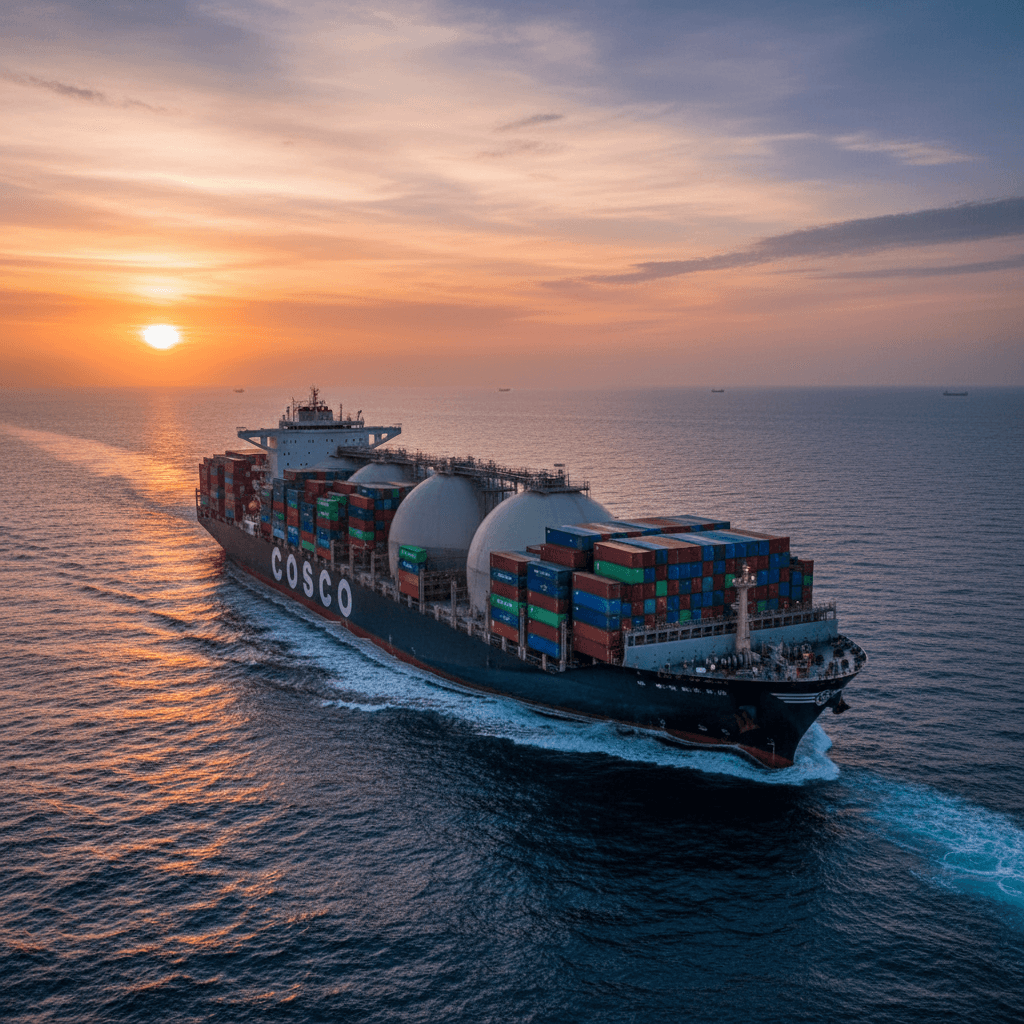
China’s state-owned shipping titan, COSCO Shipping Group, is reportedly finalizing a massive investment in its fleet renewal program. According to industry market sources and shipbrokers, the group is in advanced negotiations for a series of up to 12 Neo-Panamax container vessels, a move that could see an investment exceeding $2 billion.
Strategic Portfolio Expansion
The deal, currently being discussed with Hudong-Zhonghua Shipbuilding—a subsidiary of China State Shipbuilding Corporation (CSSC)—centers on 14,000 TEU dual-fuel ships powered by Liquefied Natural Gas (LNG). Estimates suggest each vessel carries a price tag between $170 million and $190 million, bringing the total contract value to a range of $2 billion to $2.3 billion.
Industry analysts anticipate that these newbuilds will be integrated into the operations of Orient Overseas Container Line (OOCL), COSCO’s Hong Kong-based liner subsidiary. While a definitive delivery schedule has not yet been made public, the order underscores COSCO's commitment to modernizing its capacity through environmentally conscious technology.
A Shift Toward LNG Dual-Fuel Solutions
This latest move signals a notable diversification in COSCO’s green energy strategy. While the group has previously leaned heavily toward methanol-capable designs—evidenced by OOCL’s 2025 orders for 18,500 TEU methanol dual-fuel ships—this recent pivot highlights a deepening investment in LNG as a transition fuel.
The group’s recent activity in the newbuilding market has been aggressive, including:
- A $2.7 billion order earlier this year for 12 LNG dual-fuel 18,000 TEU vessels at Jiangnan Shipyard.
- Six smaller conventionally fueled vessels commissioned at COSCO Zhoushan.
- Chartering agreements for six 13,000 TEU ships from Seaspan, slated for delivery between 2026 and 2028.
Strengthening Global Market Position
If this deal is confirmed, COSCO—currently the world’s fourth-largest liner operator—will see its orderbook surge to more than 120 ships, representing over 1.4 million TEU in total pipeline capacity. With an existing fleet of 555 vessels and approximately 3.6 million TEU of capacity, the state-run giant continues to solidify its dominance in global trade lanes while navigating the maritime industry’s complex energy transition.