
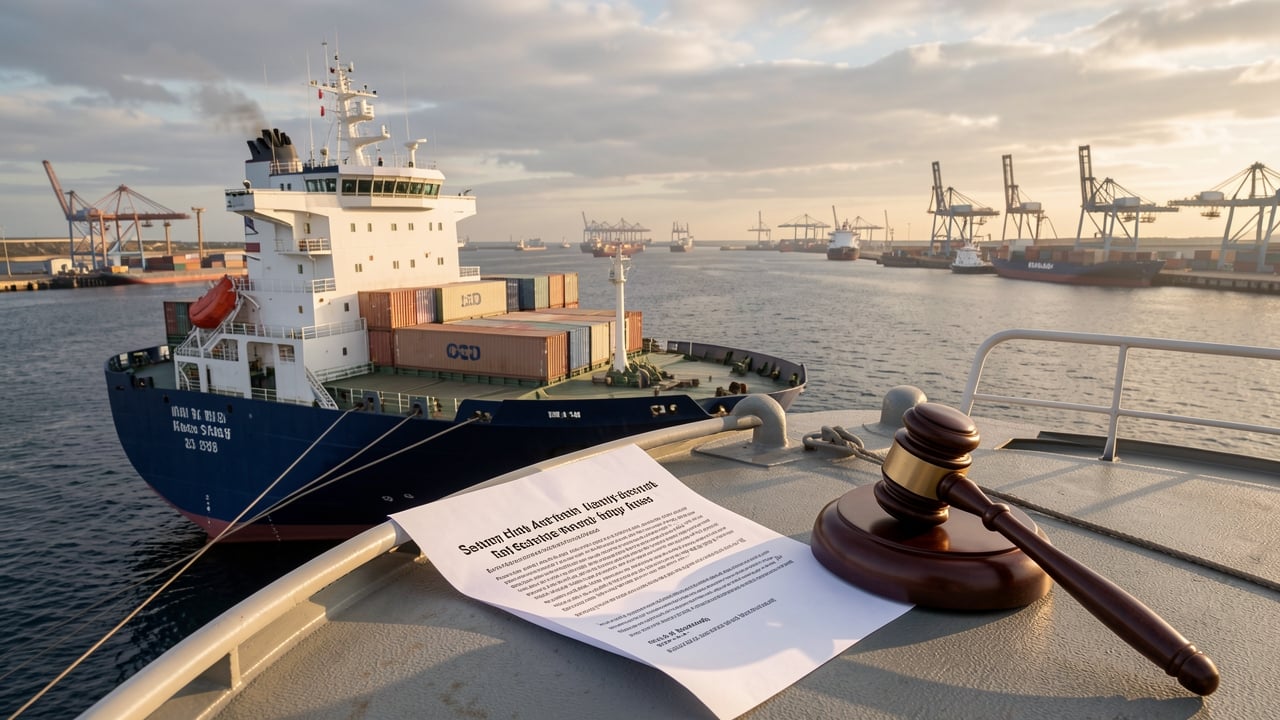
Key ruling on the intersection of security arrests and the Hague‑Visby time bar
The Court of Appeal in England has delivered a landmark judgment that separates the act of securing a maritime claim from the fulfilment of the “suit” requirement under Article III‑6 of the Hague‑Visby Rules. The decision, reported in Batavia Eximp & Contracting (S) Pte Ltd v Pedregal Maritime SA [2026] EWCA Civ 1158, reinforces the commercial certainty intended by the one‑year limitation period.
Background of the dispute
Pedregal Maritime SA owned the vessel Taikoo Brilliance and issued four bills of lading for a cargo of New Zealand pine logs destined for Kandla, India. The cargo was discharged in September 2019 without the original bills of lading, relying on a letter of indemnity from the charterer. The bill‑of‑lading holders, Batavia Eximp & Contracting (S) Pte Ltd, claimed misdelivery and sought redress.
The contracts provided for arbitration in London. Nevertheless, in August 2020—well within the one‑year period prescribed by the Hague‑Visby Rules—the claimants initiated arrest proceedings in Singapore against the sister ship Navios Koyo to obtain security. The vessel was released after security was posted, and the owners successfully obtained a stay in favour of London arbitration.
Legal issue: does an arrest for security constitute a "suit"?
Article III‑6 states that a carrier is released from liability unless “suit is brought” within one year of delivery. The crux of the case was whether the Singapore arrest, aimed solely at securing the claim, fulfilled the statutory “suit” requirement, even though the substantive dispute was slated for arbitration.
Court of Appeal’s reasoning
- Definition of suit: The court clarified that “suit” refers to proceedings intended to determine the carrier’s substantive liability, not merely to secure a claim.
- Purpose of the time bar: The rule is designed to ensure carriers receive prompt notice and that disputes are resolved without undue delay, preserving commercial finality.
- Implications of a broader interpretation: Allowing security‑only arrests to satisfy the time bar would enable claimants to postpone the substantive claim indefinitely, undermining the rule’s protective function.
The appellate judges concluded that the Singapore arrest did not qualify as a “suit.” Consequently, the one‑year limitation remained applicable, and the claimants’ arbitration, commenced in December 2020—more than a year after delivery—was barred.
Practical implications for the shipping industry
Stakeholders should note the following take‑aways:
- Arrest proceedings aimed solely at obtaining security will not preserve a claim against the Hague‑Visby time bar.
- Carriers and shippers must initiate substantive legal action—whether in court or arbitration—within the one‑year window to avoid dismissal.
- Contract clauses that prescribe arbitration must be aligned with the statutory limitation period to ensure enforceability.
The decision provides much‑needed clarity, reinforcing that security measures cannot be used as a shortcut to delay the resolution of maritime claims.
Conclusion
By distinguishing between security arrests and genuine suits, the English Court of Appeal has upheld the integrity of the Hague‑Visby time bar, signalling to the global maritime community that timely pursuit of substantive claims remains a legal imperative.