
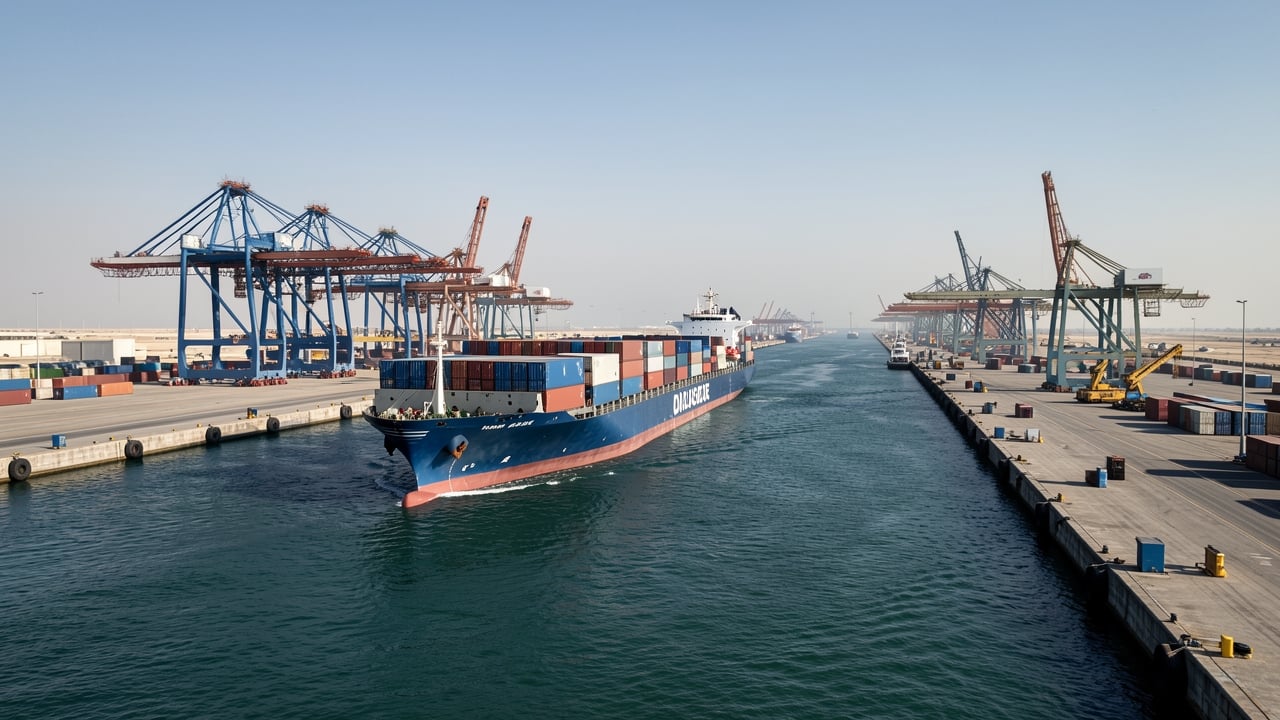
The recent shift of several major container services back to the Suez Canal has raised eyebrows across the maritime community. At first glance, the financial incentive appears modest – roughly $1 million per round‑voyage for a 24,000‑TEU vessel – but the decision is clouded by volatile war‑risk premiums, potential canal discounts, and broader network considerations.
Economic Gap Between Suez and Cape Routes
Drewry’s latest slot‑cost comparison demonstrates that the Suez route saves about $43 per slot compared with the longer Cape of Good Hope passage. While the figure sounds attractive, it excludes two critical variables that can dramatically alter the cost equation: war‑risk insurance and canal fee concessions.
War‑risk premiums erode savings
Assuming a hull valuation of $225 million for a 24,000‑TEU vessel, a one‑way war‑risk premium of just 0.3 % adds $1.35 million to a round‑trip cost. At a 1 % premium, the surcharge climbs to $4.5 million, easily outweighing the $1 million Suez advantage. Insurers sometimes rebate up to 50 % of the premium for incident‑free voyages, but the uncertainty remains a decisive factor for many operators.
Canal discounts are modest
The Suez Canal Authority may offer discounts to entice traffic. A 15 % reduction in transit fees translates to roughly $365,000 per round‑trip for a 24,000‑TEU ship; a more generous 25 % cut could reach $600,000. Even at the upper end, these savings fall short of offsetting high war‑risk premiums.
Beyond Pure Economics: Network and Service Considerations
Carriers are increasingly framing the routing decision as a network optimisation problem rather than a binary cost comparison. The key drivers include:
- Transit time: Suez shortens sailing days, preserving schedule integrity.
- Vessel utilisation: Faster turnaround supports higher fill rates and reduces idle time.
- Customer service: Direct routes sustain reliable service commitments, especially for time‑sensitive cargoes.
- Capacity allocation: Maintaining slot continuity on established Suez‑based loops simplifies fleet deployment.
Security Landscape Remains Unsettled
The original exodus from the Red Sea stemmed from heightened threats posed by Houthi‑aligned forces around the Bab al‑Mandab strait. Recent intelligence indicates the group has bolstered its presence along Yemen’s coast, expanding its geographical leverage. Despite the persisting risk, carriers appear to be weighing the strategic value of network cohesion higher than the incremental security cost.
In summary, while the raw economic benefit of the Suez Canal is thin, the combination of time savings, capacity efficiency, and customer expectations is compelling enough for many operators to accept the added risk. The evolving security environment will continue to test the resilience of this strategic choice, and insurers, regulators, and port authorities must stay closely aligned to manage the associated uncertainties.